OODA DEV
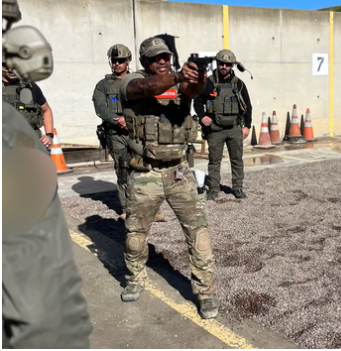
LE Tactical Handgun I
LE Tactical Handgun I
CLASSROOM AND LIVE FIRE TRAINING COURSE EMPHASIZES
- Reinforce weapon and safety condition awareness with safe weapons handling at all times
- Reinforce basic shooting fundamentals and weapon manipulations
- Threat identification and priority assessment
- Multiple-threat engagement and efficient target transitions
- Reliable malfunction clearance under operational stress
- Duty handgun manipulation efficiency and ammo management
- Introduction of shooting and moveming principles
- Performance metrics, confirmation standards, and officer diagnostics
- Predictive vs. reactive engagement principles
- Visual processing and information intake under stress
- Cognitive load management during critical incidents
- Environmental awareness and officer safety considerations
Set The Foundation to Master The Basics
This course prepares sworn law enforcement officers to deliver accurate, accountable handgun performance under real-world pressure—where time, judgment, and disciplined execution determine the outcome of a critical incident.
This course bridges the gap between qualification-based shooting and operational handgun performance. While many officers maintain firearms proficiency for agency standards, real-world critical incidents demand the ability to process information quickly, make sound decisions under pressure, and deliver accurate fire while managing time, movement, and uncertainty.
Instruction focuses on advancing the officer’s ability to efficiently run their duty handgun under stress. Building on foundational marksmanship and safe weapon handling, officers will refine malfunction clearance procedures, threat assessment, and controlled engagement techniques while maintaining accountability for every round fired.
Officers will also be introduced to critical tactical concepts including ammo management and movement during engagement. Emphasis is placed on developing disciplined performance on demand, reinforcing not only how to shoot effectively, but how to prioritize threats, adapt to rapidly changing circumstances, and articulate defensible use-of-force decisions.
This course is moderately more physically and cognitively demanding than basic firearms training. Its purpose is to identify performance gaps, strengthen decision-making under stress, and build confidence in the officer’s ability to prevail in a lethal-force encounter while maintaining professional accountability.
Participants will leave with improved capability to self-diagnose performance, apply measurable standards, and operate predictively rather than reactively—a critical factor when seconds determine outcomes.
This training is designed for law enforcement professionals who understand that qualification alone is not preparation for a critical incident.
INDIVIDUAL EQUIPMENT LIST:
Students should bring the following duty equipment used in their daily assignment:
REQUIRED:
- Duty handgun (agency-issued or approved)
- Minimum 3 magazines (5 recommended)
- 500 rounds of duty-caliber ammunition
- Duty belt with holster and magazine pouches
- Eye and ear protection
- Baseball cap or brimmed hat
- Hydration and weather-appropriate clothing
Recommended But Not Required
- Weapon-mounted light (if issued or authorized)
- Body armor or outer carrier
- Tourniquet / individual trauma kit
Training will be conducted from duty gear configuration whenever possible to ensure skill development translates directly to operational use.
Share