OODA DEV
Team Tactics
Team Tactics
Coordinated Movement. Decisive Action. Disciplined Execution.
Modern law enforcement operations demand more than individual capability—they require synchronized team performance under pressure, often in environments that are rapidly evolving, uncertain, and high-risk.
Our Team Tactics training is a comprehensive training program designed to develop officers’ ability to operate effectively within two-, three-, four or more elements and full team deployments in close-quarters environments. Grounded in real-world operational experience, this course emphasizes decision-making, communication, coordinated movement and throttle control to achieve safe, effective, and legally defensible outcomes.
CUSTOMIZED TRAINING DELIVERY
All OODA DEVelopment Solutions Team Tactics programs are delivered at client-designated training locations and can be tailored to meet the specific needs, policies, and operational realities of your agency.
Courses can be conducted in:
- Dry-fire movement only with shoot / no shoot targets
- Force-on-force scenarios utilizing non-lethal training ammunition (e.g., simunition / UTM) and live role players
- Combination of the above
Each program is scalable and adaptable based on:
- Facility constraints
- Available personnel
- Agency-specific SOPs
- Desired training outcomes
Training can be customized to address your agency’s specific priorities, including:
- Surround and Call-Out Operations
- De-escalation in team environments
- Tactical Drone Integration (Overwatch & Interior Clearance Support)
- Covert / Deliberate Clearance
- Dynamic Clearance
- Hostage Rescue / Sniper-Initiated Hostage Rescue / Vehicle HR
- Linear Tactics (buses, trains, subways, aircraft)
- Direct-to-Contact Response
- Active Threat / Active Shooter Response
If your agency has a specific operational gap or training objective, we will build the program around it.
Contact us to discuss your team’s mission requirements and training goals.
COURSE FOUNDATION
This program develops the integration of:
- Cognitive processing under stress
- Team-based movement and communication
- Legally defensible decision-making
- Threat prioritization and discrimination
- Control of tempo, timing, and spacing
Officers learn to operate through the OODA Loop as a unified element, ensuring clarity, accountability, and adaptability in high-stakes environments.
CORE TRAINING OBJECTIVES
Individual Performance Within the Team
- Weapons handling efficiency under team conditions
- Application of shooting fundamentals in confined environments
- Understanding operational timelines (who is driving the tempo)
- Maintaining individual accountability within team movement
Team Structure & Movement
- Roles and responsibilities within 2–4 officer elements
- Actions at the point of entry (breach considerations)
- Sector responsibility and threat coverage
- Hallway movement (wide vs. narrow formations)
- Managing opposing threat areas and dead space
- Blocking positions to support team flow
- Timing, spacing, and coordinated movement
Communication & Coordination
- Verbal and non-verbal communication under stress
- Movement initiation and leadership responsibilities
- Deconfliction in multi-room and multi-team environments
- Cross-coverage and accountability for fields of fire
Environmental Problem Solving
- Center-fed vs. corner-fed room structures
- Multi-room prioritization and decision-making
- Stairwell and vertical movement considerations
- Low-light / no-light operations
CLOSE QUARTERS CLEARANCE PRINCIPLES
Deliberate Clearance
Focuses on controlled, information-driven movement to identify threats, minimize unnecessary exposure, and maintain decision superiority.
Officers will train in:
- Establishing SOPs and threat priorities
- Identifying pre-incident and in-incident threat indicators
- Threat discrimination and lawful engagement decisions
- Limited penetration (“threshold evaluation”) for one- and two-officer elements
- Two- and four-officer deliberate room entries
- Effective use of angles, cross-coverage, and visual dominance
- Managing multiple connected spaces
- Hallway and stairwell navigation
- Single vs. multiple entry point considerations
- Team scalability based on available personnel
- Low-light CQB considerations
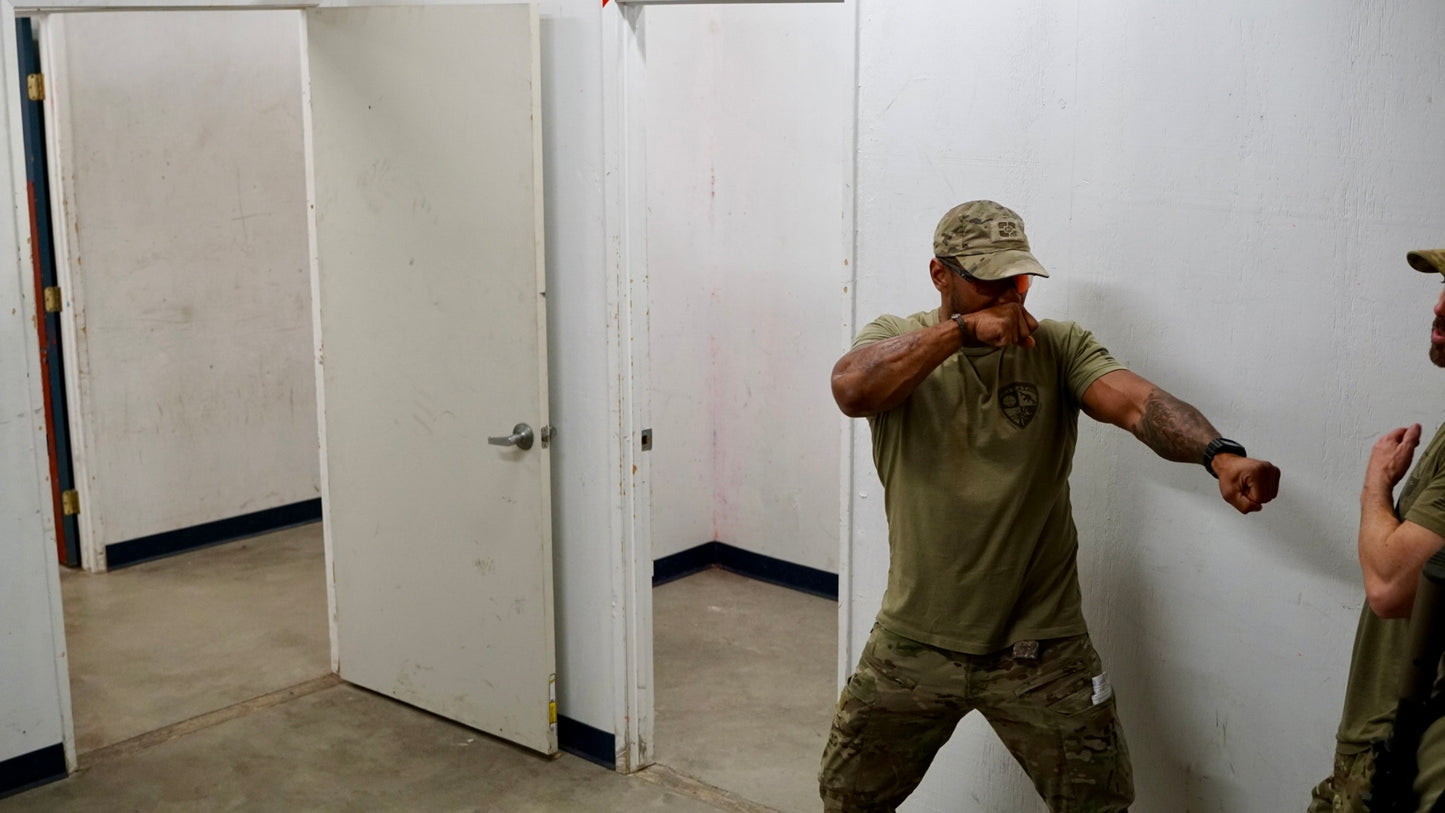
- Integration of defensive tactics in confined spaces
DYNAMIC AND DIRECT TO THREAT CQC FOR HIGH-RISK OPERATIONS
Certain incidents require rapid intervention and decisive action under compressed timelines. This block addresses the shift from deliberate to dynamic operations when circumstances dictate.
Officers will develop:
- Understanding of high-risk entry priorities and decision thresholds
- Rapid threat identification and prioritization
- Dynamic two or more entry techniques
- Movement techniques to rapidly dominate space and disrupt threats
- Multi-room management during fluid, evolving incidents
- Deconfliction during accelerated team operations
- Hallway and stairwell movement under urgency
- Diversion and distraction considerations
- Low- or no-light operations in dynamic environments
- Post-engagement priorities and accountability
FREE FLOW VS. DELIBERATE CLEARANCE
Officers will be trained to understand and apply:
- Direct to Threat or Free Flow CQC – continuous movement, adaptability, and speed
- Deliberate / Limited Penetration – control, information gathering, and risk mitigation
The focus is on decision-making, ensuring officers select the appropriate method based on:
- Mission objectives
- Threat level
- Priority of life
- Environment
- Available resources
TRAINING METHODOLOGY
- Progressive instruction (crawl → walk → run)
- Scenario-based problem solving
- Force-on-force validation (when applicable)
- Immediate feedback and performance diagnostics
- Emphasis on repeatable, accountable performance under stress
WHO THIS COURSE IS FOR
- Patrol officers
- Plainclothes / undercover personnel
- Federal Agents / Task Force Officers
- Tactical / SWAT teams
- Multi-agency response elements
END STATE
Officers will be able to:
- Operate cohesively within a team in high-risk environments
- Communicate and move with clarity and purpose
- Adapt tactics based on evolving threats and conditions
- Make sound, legally defensible decisions under pressure
Train with purpose. Execute with clarity. Prevail with discipline.
Contact us to discuss how we can be of service.
Share